

Introduction
In Korea, drinking isn’t just about alcohol. It’s about relationships.
Whether it’s coworkers bonding after a long project, old friends catching up, or new acquaintances breaking the ice, alcohol plays a central role in Korean social life. Sharing drinks is how Koreans build trust, open up to each other, and strengthen connections.
But Korean drinking culture comes with its own set of customs and unwritten rules. From how you pour a drink to how you receive one, there are traditions that might surprise you if you’re not familiar with them.
In this guide, I’ll walk you through everything you need to know about Korean drinking culture — the types of alcohol, the etiquette, and the unique customs that make drinking in Korea a cultural experience unlike anywhere else.
Why Drinking is Important in Korean Culture
To understand Korean drinking culture, you need to understand why it matters so much.
Building Relationships
The phrase “한 잔 하자” (let’s have a drink) is essentially an invitation to become closer. Koreans believe that people reveal their true selves when they drink together. It’s easier to have honest conversations, share personal stories, and break down social barriers over a bottle of soju.
Work Culture (회식)
In Korean work culture, team dinners with alcohol — called “회식” (hoesik) — have been a longstanding tradition. It’s seen as a way for colleagues to bond outside the office. While the culture is changing (more on that later), hoesik remains an important part of professional life.
Stress Relief
Korea is known for its high-pressure work and study environment. Drinking has traditionally served as an outlet — a way to decompress, vent frustrations, and temporarily escape daily stress.
Types of Korean Alcohol
Korea has a variety of alcoholic drinks, each with its own character and drinking style.
Soju (소주)
The most iconic Korean alcohol. Soju is a clear spirit with an alcohol content of around 16-20%. It’s smooth, slightly sweet, and dangerously easy to drink. Soju is cheap, available everywhere, and the default choice for most Korean drinking sessions.
Beer (맥주)
Korean beers like Cass and Hite are light lagers, perfect for casual drinking. But the real magic happens when you mix beer with soju to make “somaek” (소맥) — a popular combination that’s smoother than straight soju but stronger than beer.
Makgeolli (막걸리)
A traditional Korean rice wine with a milky appearance and slightly sweet, tangy taste. Makgeolli is lower in alcohol (around 6-8%) and often paired with savory pancakes like pajeon. It’s the oldest Korean alcohol, with a history going back thousands of years.
Fruit Soju (과일소주)
Flavored soju variants with grapefruit, grape, peach, or other fruit flavors. These are sweeter and easier to drink, popular among younger drinkers and those who find regular soju too strong.
Traditional Liquors (전통주)
Korea has countless regional traditional alcohols, from Andong soju to various flower-infused wines. These are often higher quality and enjoyed on special occasions.
Korean Drinking Etiquette
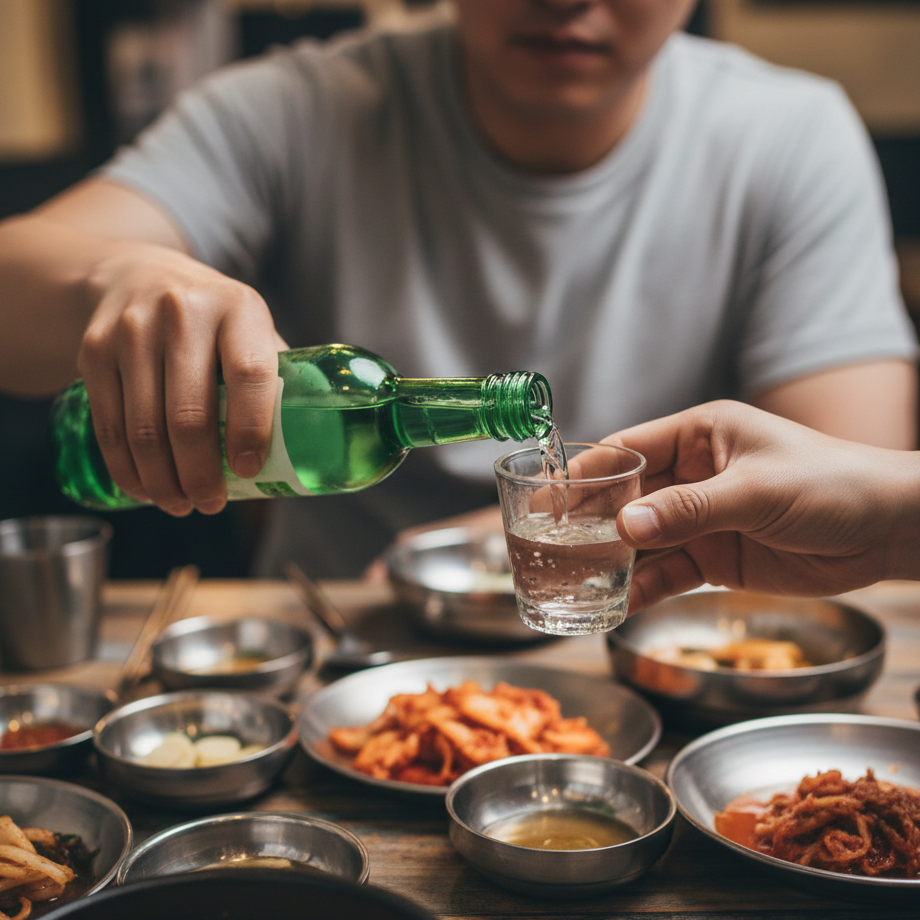
Here’s where Korean drinking culture gets unique. There are specific customs for pouring, receiving, and drinking that show respect — especially toward elders and seniors.
How to Pour
When pouring a drink for someone older or senior to you, use both hands — one hand on the bottle, the other supporting your arm or the bottom of the bottle. This shows respect.
Never pour your own drink. In Korea, you pour for others, and they pour for you. If someone’s glass is empty, it’s polite to refill it. Likewise, if your glass is empty, someone will usually fill it for you.
How to Receive
When receiving a drink from someone older or senior, hold your glass with both hands. Alternatively, hold the glass with one hand and place your other hand on your chest or support your receiving arm.
This two-handed gesture is a sign of respect and is used in many Korean customs beyond drinking.
How to Drink
When drinking in front of someone older or senior, turn your head slightly to the side. Don’t face them directly while drinking — it’s considered more respectful to turn away.
For the first drink of the night, everyone typically drinks together after a group toast. “원샷” (one shot) — finishing the entire glass in one go — is common for the first round, though not mandatory.
Common Drinking Expressions
Here are some Korean phrases you’ll hear at any drinking gathering.
건배! (Geonbae!) “Cheers!” — The standard toast before drinking together.
위하여! (Wihayeo!) “For [something]!” — Often used as “우리의 건강을 위하여!” (To our health!) or to celebrate a specific occasion.
원샷! (One shot!) “Drink it all at once!” — Usually shouted enthusiastically.
한 잔 더? (Han jan deo?) “One more drink?” — A common question as the night goes on.
오늘 내가 쏜다 (Oneul naega ssonda) “I’m buying today” — When someone offers to pay for the drinks.
Drinking Food Culture (안주)
In Korea, you almost never drink without food. “안주” (anju) refers to food eaten while drinking, and it’s considered essential — drinking on an empty stomach is frowned upon.
Popular Anju
Some classic drinking foods include Korean fried chicken (the ultimate beer companion), samgyeopsal (grilled pork belly), ojingeo (dried squid), golbaengi (sea snails in spicy sauce), and haemul pajeon (seafood pancake). For soju, savory and slightly greasy foods work best. For makgeolli, pajeon is the traditional pairing.
The Culture of Sharing
Anju is always shared among the table. You order several dishes for everyone to pick from — it’s part of the communal drinking experience.
Hoesik: Korean Work Dinner Culture
“회식” (hoesik) refers to company dinners where coworkers eat and drink together. It’s been a cornerstone of Korean corporate culture for decades.
The 1차, 2차, 3차 System
Korean nights out often don’t end after one location. Instead, they progress through multiple rounds.
1차 (First round): The main dinner and drinks. This is where most of the eating happens, usually at a Korean BBQ restaurant or a traditional drinking spot.
2차 (Second round): After dinner, the group often moves to another location — commonly a noraebang (karaoke room) or a different bar. The drinking continues, but in a more relaxed, fun setting.
3차 (Third round): For those with more stamina, a third location might follow — sometimes another bar, a PC bang (gaming café), or even a late-night snack spot.
Not everyone stays for all rounds. It’s perfectly acceptable to leave after 1차, especially if you have family waiting at home or an early morning the next day.
Modern Changes in Korean Drinking Culture
Korean drinking culture is evolving, especially among younger generations.
No More Forced Drinking
In the past, refusing a drink from a senior could be seen as disrespectful. Today, that’s changing. Saying “no” is increasingly accepted, and pressuring someone to drink is now considered inappropriate. Many companies have official policies against forced drinking.
Rise of Honhul (혼술)
“혼술” means drinking alone, and it’s become a trend. More Koreans are comfortable enjoying a quiet drink by themselves at home or at a bar — something that would have been unusual a generation ago.
Low-Alcohol and Non-Alcoholic Options
Younger Koreans are drinking less than previous generations. Low-alcohol drinks, zero-alcohol beer, and non-alcoholic cocktails are growing in popularity. Health consciousness is changing drinking habits.
MZ Generation Differences
Millennials and Gen Z in Korea often prefer quality over quantity. Instead of drinking heavily to bond, they might choose craft beer, wine, or just a couple of drinks in a comfortable setting.
Tips for Foreigners
If you find yourself drinking in Korea, here’s what you should know.
You Can Say No
Despite the traditions, you won’t offend anyone by politely declining a drink today. A simple “괜찮아요, 저는 술을 잘 못해요” (I’m okay, I can’t drink much) is perfectly acceptable.
Use Two Hands
Even if you forget everything else, just remember to receive drinks with two hands when drinking with older Koreans. This small gesture goes a long way.
Follow the Lead
If you’re unsure what to do, just watch what others are doing and follow along. Koreans don’t expect foreigners to know all the rules — they’ll appreciate that you’re trying.
Try a Hangover Cure
Koreans take hangovers seriously. Drinks like “컨디션” (Condition) or “상쾌환” (Sangkwaehwan) are sold at every convenience store and pharmacy. Many Koreans take these before drinking to prevent hangovers. They actually work surprisingly well.
My Korean Drinking Story
One of my most memorable drinking experiences was a company hoesik after finishing a big project.
About 12 of us gathered at a bar in Hongdae to celebrate. We ordered all the classics: budae jjigae (army stew), fried chicken, odeng tang (fish cake soup), and haemul pajeon (seafood pancake). The drinks of choice? Somaek — soju mixed with beer.
Before anyone took their first sip, something interesting happened. Everyone pulled out hangover medicine and took it right there at the table. I don’t remember the exact brand — it was one of those common ones you can buy at any pharmacy — but apparently taking it before you drink helps prevent the next morning’s pain. It was my first time seeing an entire group do this together, and I realized just how seriously Koreans prepare for a night of drinking.
As the night went on and the bottles emptied, the conversations got deeper. We talked about the struggles of the project, the funny moments, the stressful deadlines. The food was delicious, but honestly, the real “anju” that night was our shared stories. Time flew by without any of us noticing.
I left after the first round — my wife was waiting at home, and I knew my limits. I caught the subway back while I could still walk straight.
But some teammates continued to 2차 — a noraebang. They sang, drank more, and eventually some of them caught the last subway home.
And then there were the brave ones who went to 3차 — a PC bang. They played games all night, ate ramyeon for a late-night hangover meal, and didn’t leave until the first subway started running in the early morning.
I don’t have that kind of stamina anymore. But apparently some young Koreans in their twenties do. The commitment is impressive, honestly.
That night showed me everything about Korean drinking culture in one experience: the shared food, the deepening conversations, the rounds of 1차-2차-3차, and the way alcohol brings people together in a way that’s hard to replicate otherwise.
Final Thoughts
Korean drinking culture is about more than just alcohol. It’s about connection.
The rules and etiquette exist to show respect. The rounds of 1차, 2차, 3차 exist to extend the time spent together. The food exists because Koreans believe you should take care of each other, even while drinking.
If you ever have the chance to join a Korean drinking session, embrace it. Learn a few phrases, use two hands when someone pours you a drink, and let the conversations flow naturally.
Just maybe take some hangover medicine first.