

Introduction
If there’s one skincare step that Koreans take seriously, it’s sunscreen.
Walk into any Korean convenience store, drugstore, or beauty shop, and you’ll find an entire wall dedicated to sunscreen — creams, gels, essences, sticks, sprays, and even cushion compacts. The variety is overwhelming, and there’s a reason for it.
Korean sunscreen isn’t just about sun protection. It’s lightweight, comfortable to wear, and feels nothing like the thick, greasy sunscreens most people are used to. Once you try a Korean sunscreen, it’s hard to go back to anything else.
In this guide, I’ll explain why Korean sunscreen is different from what you’ll find in other countries, how to choose the right one for your skin, and why it’s one of the most important skincare investments you can make.
Why Koreans Take Sunscreen Seriously
In Korea, sunscreen isn’t just a summer product — it’s considered an essential step in daily skincare.
The reason is simple: UV exposure is the number one cause of premature skin aging. Wrinkles, dark spots, uneven skin tone, and loss of elasticity — most of these are caused more by sun damage than by age itself. Korean skincare philosophy focuses on prevention rather than correction, and sunscreen is the most effective preventive tool there is.
That doesn’t mean every Korean applies sunscreen religiously every single day. But there’s a general awareness that protecting your skin from the sun matters. At the very least, most Koreans make sure to apply sunscreen when going outside during summer. And among those who are more serious about skincare, applying sunscreen indoors — especially near windows — is a common habit.
The mindset is straightforward: it’s easier to protect your skin now than to try to fix the damage later.
Korean Sunscreen vs Western Sunscreen
If you’ve ever used a Western sunscreen and hated the heavy, greasy feeling, Korean sunscreen will feel like a completely different product. Here’s how they compare.
Texture
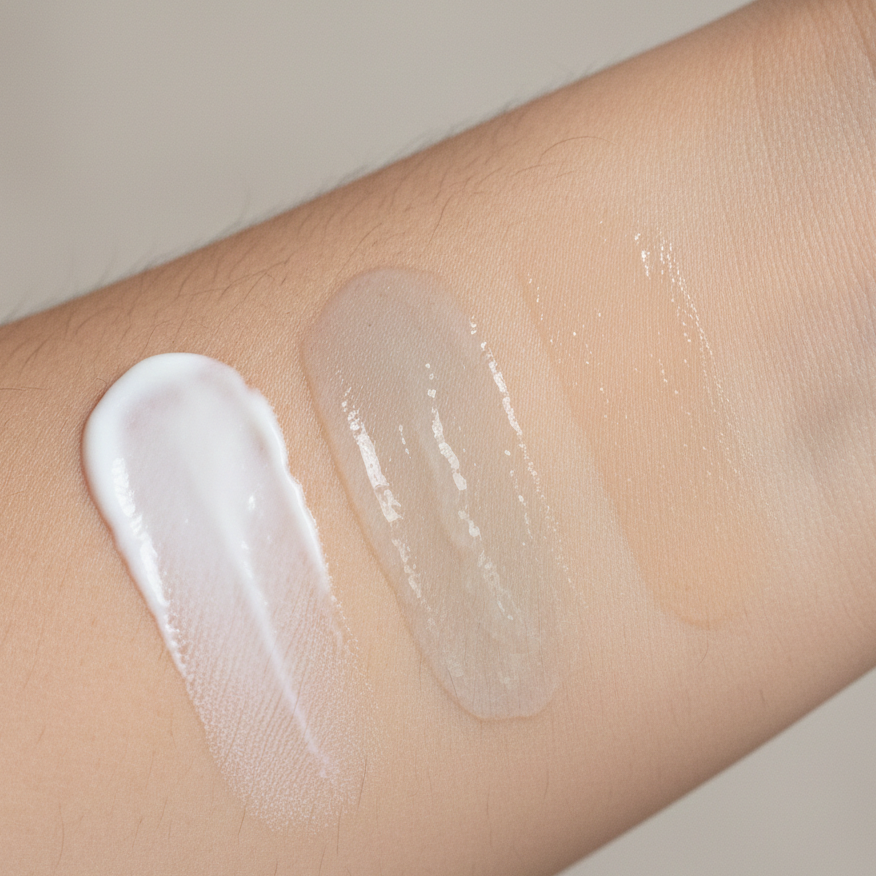
Western sunscreens tend to be thick, heavy, and leave a noticeable film on the skin. Korean sunscreens are formulated to feel lightweight — many have the consistency of a moisturizer or even a watery essence. You barely notice you’re wearing sunscreen at all.
White Cast
One of the biggest complaints about sunscreen is the white, chalky residue it leaves on skin. This is especially noticeable on darker skin tones. Korean sunscreens are specifically designed to minimize or eliminate white cast entirely, blending seamlessly into the skin.
Finish
Many Korean sunscreens double as makeup primers. They create a smooth, slightly dewy or matte base that works well under makeup — or on its own. Some even come with a subtle tone-up effect that brightens and evens out your skin tone.
UV Filter Technology
Korea uses newer-generation UV filters that provide strong protection while maintaining a light, elegant texture. These filters are often more cosmetically elegant than the older filters commonly used in Western products.
SPF and PA System
In Korea, sun protection is measured by two ratings. SPF (Sun Protection Factor) measures protection against UVB rays, which cause sunburn. PA (Protection Grade of UVA) measures protection against UVA rays, which cause deeper skin aging. The PA rating uses plus signs — PA+, PA++, PA+++, PA++++. Look for PA++++ for the highest level of UVA protection. Most Korean sunscreens offer SPF 50+ PA++++, giving you comprehensive protection against both types of UV rays.
Types of Korean Sunscreen
Korean sunscreens come in many different formulas. Understanding the types will help you find the one that works best for you.
Chemical Sunscreen
Uses chemical UV filters that absorb UV rays and convert them into heat. These are the lightest and most comfortable to wear. They blend into the skin without any white cast and feel almost invisible. Best for daily use and under makeup.
Physical (Mineral) Sunscreen
Uses mineral ingredients like zinc oxide or titanium dioxide that sit on top of the skin and reflect UV rays. These are gentler and less likely to irritate sensitive skin. They can leave a slight white cast, though Korean formulas have minimized this significantly.
Hybrid Sunscreen
Combines both chemical and physical filters for balanced protection. These offer the comfort of chemical sunscreens with the gentle protection of physical ones.
By Texture
Korean sunscreens come in a variety of textures to suit every preference. Cream types are rich and hydrating, ideal for dry skin. Gel types are lightweight and refreshing, great for oily skin. Essence and fluid types are watery and absorb quickly. Stick types are convenient for reapplication on the go. Tone-up types add a brightening effect to your skin. Cushion types come in compact form, perfect for touch-ups throughout the day.
How to Choose the Right Korean Sunscreen
With so many options, choosing the right sunscreen comes down to your skin type and lifestyle.
For Oily Skin
Look for gel or essence-type sunscreens with a matte or sebum-control finish. These absorb quickly and won’t make your skin look shiny. Water-based formulas work best.
For Dry Skin
Choose cream-type sunscreens with added hydrating ingredients like hyaluronic acid or ceramides. These provide moisture while protecting your skin, so your face doesn’t feel tight or flaky.
For Sensitive Skin
Physical (mineral) sunscreens are your safest bet. They sit on top of the skin rather than being absorbed, which means less chance of irritation. Look for fragrance-free, hypoallergenic formulas.
For Everyday Use
SPF 50+ PA++++ is the standard recommendation for daily protection. Even if you’re just commuting to work or running errands, this level of protection is worth it.
For Outdoor Activities
Choose a water-resistant formula and reapply every two hours. Stick-type sunscreens are great for reapplication when you’re out and about.
How to Apply Sunscreen Properly
Even the best sunscreen won’t work if you don’t apply it correctly. Here are the key rules.
Use Enough
The most common mistake is not using enough. The recommended amount for your face is about two finger-lengths — squeeze a line of sunscreen along your index and middle fingers. Most people use only a third of what they should, which dramatically reduces protection.
Apply It Last
Sunscreen goes on as the final step of your skincare routine, after moisturizer and before makeup. This ensures it forms an even protective layer on top of your skin.
Reapply Every 2-3 Hours
Sunscreen breaks down over time, especially with sweat, oil, and friction. If you’re outdoors for extended periods, reapply every two to three hours. Cushion-type or stick-type sunscreens make this easy without disturbing your makeup.
Wear It Indoors Too
UVA rays penetrate through windows. If you sit near a window at home or in the office, your skin is still exposed. This is why some people in Korea apply sunscreen even on days they don’t leave the house.
Common Sunscreen Mistakes
Even regular sunscreen users make these mistakes without realizing it.
Not applying enough
This is the biggest one. A thin layer might feel comfortable, but it provides far less protection than the SPF number on the bottle promises. Be generous with the amount.
Skipping reapplication
One morning application doesn’t last all day. If you’re outside, you need to reapply. No exceptions.
Skipping sunscreen on cloudy days
Up to 80% of UV rays pass through clouds. Overcast skies don’t mean your skin is safe.
Using body sunscreen on your face
Body sunscreens are formulated differently — they’re thicker, heavier, and can clog facial pores. Always use a sunscreen designed for the face.
Forgetting your neck and ears
Your face isn’t the only area exposed to the sun. Apply sunscreen to your neck, ears, and any other exposed skin for complete protection.
My Sunscreen Story
I’ll be honest — I don’t apply sunscreen every single day. I mainly use it during summer when I’m going outside, and I know I’m not alone in that. Not every Korean walks around with SPF 50 on their face 365 days a year. That’s a bit of a myth.
But here’s what I’ve noticed over the years: sun protection makes a visible difference.
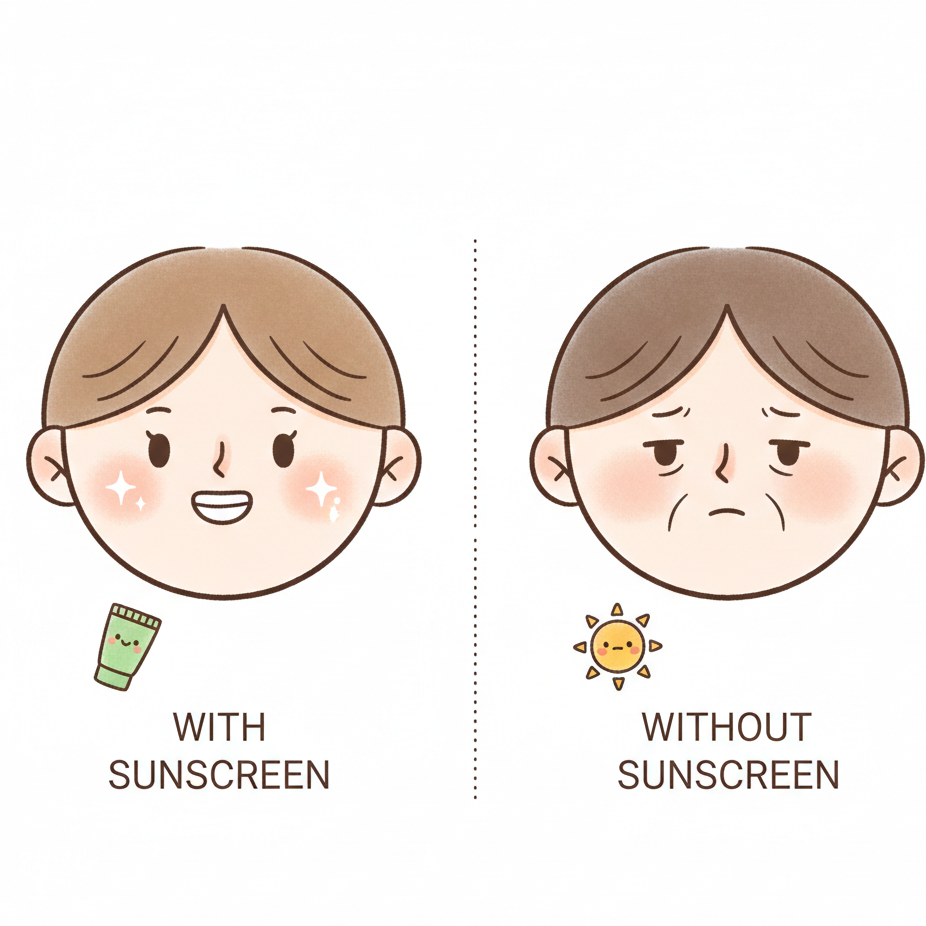
I have friends who never bothered with sunscreen — not once, not even in the middle of summer. And now, compared to other friends the same age, the difference is obvious. Their skin looks noticeably older, more damaged, with deeper wrinkles and uneven tone. It’s the kind of thing you don’t notice year by year, but when you compare people in their thirties who protected their skin versus those who didn’t, it’s written all over their faces.
That’s what convinced me. I’m not the most disciplined sunscreen user, but it’s something I’m trying to be better about. Even if you don’t follow a full skincare routine, just adding sunscreen is probably the single most impactful thing you can do for your skin long-term.
In Korea, most people understand this at some level. At minimum, they’ll put on sunscreen before spending time outside in summer. The more dedicated ones apply it every morning, rain or shine, indoors or outdoors. Wherever you fall on that spectrum, the important thing is that you’re doing something.
Start with summer. Start with outdoor days. Build the habit from there. That’s what I’m doing, and honestly, it’s good enough.
Final Thoughts
Korean sunscreen changed the way the world thinks about sun protection. It proved that sunscreen doesn’t have to be heavy, greasy, or unpleasant to wear. It can be lightweight, hydrating, and even make your skin look better.
If you’ve been skipping sunscreen because you hate the way it feels, try a Korean one. Just once. You’ll understand immediately why millions of people around the world have made the switch.
Your future self — with fewer wrinkles and healthier skin — will thank you.